
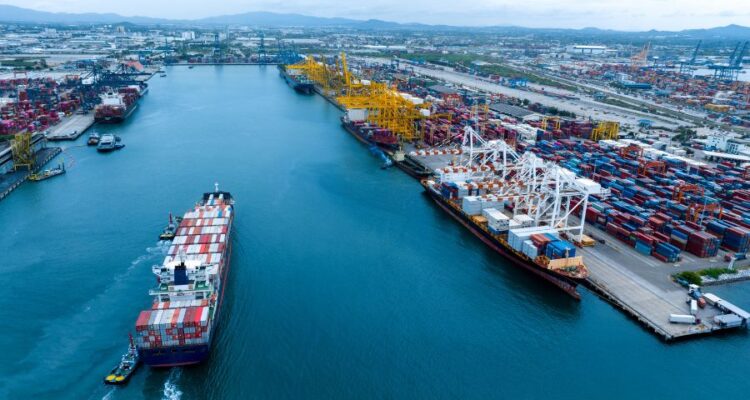
The China–Europe Arctic shipping route is moving from a long-term concept toward a commercially relevant option for global trade. In August 2026, China launched a regular cargo service through Russia’s Northern Sea Route (NSR), connecting China with Northern Europe. Sea Legend’s Arctic Express service has reportedly linked Ningbo-Zhoushan with Felixstowe in around 18 days, highlighting the potential of the Arctic corridor as an alternative to traditional China–Europe routes.
For freight forwarders, however, the route represents both an opportunity and a complex operational challenge.
The Northern Sea Route follows Russia’s Arctic coastline and can significantly reduce the sailing distance between Asia and Northern Europe compared with traditional routes. The route has attracted additional attention in 2026 as disruptions around major maritime chokepoints have increased pressure on global supply chains.
For businesses moving time-sensitive cargo, shorter transit times could improve inventory planning and reduce exposure to prolonged ocean journeys. This creates opportunities for an international freight forwarder to offer customers alternative routing strategies rather than relying on a single trade lane.
The Arctic corridor is still seasonal, but recent voyages demonstrate that commercial services are becoming more practical during favorable navigation periods.
The biggest attraction is transit time. The 2026 Arctic Express voyage has demonstrated a China–Northern Europe journey of roughly 18–20 days.
Freight forwarders could use this shorter routing option for selected cargo where speed has a significant commercial value. It may be particularly relevant for manufactured goods, technology products, electric vehicles, and other time-sensitive shipments.
Recent disruptions have shown why global supply chains need multiple routing options. The Arctic corridor gives logistics providers another potential route between Asia and Europe.
For companies offering freight forwarding and international logistics solutions, incorporating Arctic routing into contingency planning could help customers respond to congestion, geopolitical disruptions, or capacity shortages on conventional routes.
The development of Arctic shipping can create demand beyond ocean transportation. Freight forwarders may need to coordinate documentation, port handling, customs procedures, cargo monitoring, and inland transportation at both ends.
This creates opportunities for integrated services such as customs brokerage, warehouse services, and shipment coordination. For Heritage International Freight Limited, such developments reinforce the importance of providing flexible logistics solutions , around changing global trade routes.
Unlike conventional year-round trade lanes, Arctic shipping remains heavily influenced by ice conditions and seasonal accessibility. Weather and ice can affect sailing schedules, making reliable transit planning more complicated.
Freight forwarders therefore need realistic contingency plans rather than treating the Arctic route as a direct replacement for established China–Europe services.
Arctic operations require vessels and equipment capable of handling polar conditions. The International Maritime Organization’s Polar Code establishes mandatory requirements covering ship design, equipment, operations, training, safety and environmental protection in applicable polar waters. Amendments to the Polar Code entered into force on 1 January 2026, expanding safety and voyage-planning requirements for certain smaller vessels.
This can increase operational complexity and costs compared with standard container shipping.
The Northern Sea Route largely depends on Russian infrastructure and permissions. Current geopolitical tensions and sanctions create additional considerations for companies evaluating the route. Recent Arctic shipments have also demonstrated the connection between the route and Russia’s broader energy and trade strategy.
Freight forwarders must therefore assess sanctions exposure, documentation, insurance, carrier availability, and destination-country requirements before recommending an Arctic routing.
The Arctic is an environmentally sensitive region. Increased shipping activity raises concerns about pollution, black carbon, and the potential consequences of accidents in remote waters. The IMO Polar Code specifically addresses environmental protection alongside operational safety.
Sustainability considerations are likely to become increasingly important when companies compare Arctic shipping with other routes.
The China–Europe Arctic shipping route should currently be viewed as an emerging option rather than a complete replacement for established trade lanes. Its shorter transit potential is attractive, but seasonal navigation, specialised vessels, geopolitical considerations, and limited infrastructure remain significant barriers.
For an international freight forwarder, the key will be understanding which cargo, customers, and circumstances genuinely benefit from Arctic routing. Accurate freight tracking and proactive shipment monitoring will also become increasingly important when operating in a route where weather and ice can affect schedules.
Heritage International Freight Limited can approach this changing environment by focusing on flexible routing, compliance, shipment visibility, and customer-specific logistics planning. As Arctic commercial shipping develops, freight forwarders that can evaluate both its opportunities and risks and will be better positioned to support evolving China–Europe trade.
In 2026, China’s Arctic Express service demonstrated a China–Northern Europe transit of approximately 18–20 days, although actual transit times can vary.
No. Arctic navigation is strongly affected by seasonal ice conditions. Accessibility and vessel requirements can vary depending on the time of year and route conditions.
Key risks include ice and weather conditions, specialized vessel requirements, regulatory compliance, geopolitical uncertainty, insurance considerations, and limited infrastructure.
Not in the immediate future. It is more likely to function as an additional routing option for selected cargo while conventional routes continue to handle the majority of China–Europe trade.
[…] businesses involved in freight forwarding, customs clearance, and international logistics, this shift could change how trade documents and supply-chain information are […]